


MESSAGE メッセージ
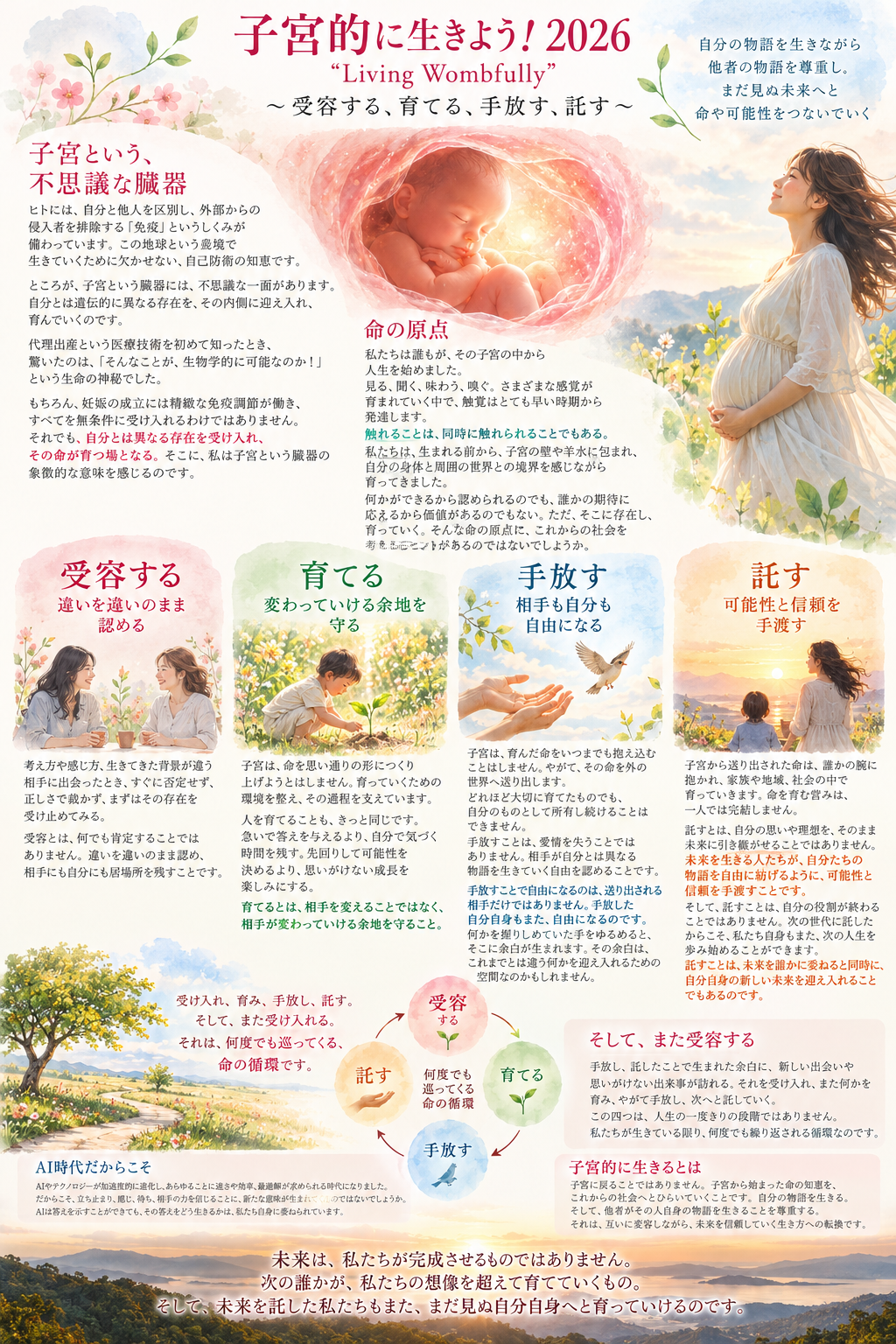
子宮的に生きよう!2026
“Living Wombfully”
~受容する、育てる、手放す、託す~
ヒトには、自分と他人を区別し、外部からの侵入者を排除する「免疫」というしくみが備わっています。この地球という環境で生きていくために欠かせない、自己防衛の知恵です。
ところが、子宮という臓器には、不思議な一面があります。自分とは遺伝的に異なる存在を、その内側に迎え入れ、育んでいくのです。
私が代理出産という医療技術を初めて知ったとき、驚いたのは、倫理的な問題以前に、「そんなことが、生物学的に可能なのか!」という生命の神秘でした。自分とは遺伝的につながりのない受精卵であっても、条件が整えば、子宮の中で育っていくことができる。
もちろん、妊娠の成立には精緻な免疫調節が働き、すべてを無条件に受け入れるわけではありません。それでも、自分とは異なる存在を受け入れ、その命が育つ場となる。
そこに、私は子宮という臓器の象徴的な意味を感じるのです。
私たちは誰もが、その子宮の中から人生を始めました。
見る、聞く、味わう、嗅ぐ。さまざまな感覚が育まれていく中で、触覚はとても早い時期から発達します。触れることは、同時に触れられることでもあります。私たちは、生まれる前から、子宮の壁や羊水に包まれ、自分の身体と周囲の世界との境界を感じながら育ってきました。
何かができるから認められるのでも、誰かの期待に応えるから価値があるのでもない。ただ、そこに存在し、育っていく。そんな命の原点に、これからの社会を考えるヒントがあるのではないでしょうか。
受容する。
考え方や感じ方、生きてきた背景が違う相手に出会ったとき、すぐに否定せず、正しさで裁かず、まずはその存在を受け止めてみる。
受容とは、何でも肯定することではありません。違いを違いのまま認め、相手にも自分にも居場所を残すことです。
育てる。
子宮は、命を思い通りの形につくり上げようとはしません。育っていくための環境を整え、その過程を支えています。
人を育てることも、きっと同じなのでしょう。
急いで答えを与えるより、自分で気づく時間を残す。先回りして可能性を決めるより、思いがけない成長を楽しみにする。
育てるとは、相手を変えることではなく、相手が変わっていける余地を守ること。
手放す。
子宮は、育んだ命をいつまでも抱え込むことはしません。
やがて、その命を外の世界へ送り出します。
どれほど大切に育てたものでも、自分のものとして所有し続けることはできない。子どもも、仕事も、役割も、そして自分が築いてきた価値観さえも。
私たちは、大切にしてきたものほど、手放すことをためらいます。自分が育てたのだから、自分が守らなければならない。自分が始めたのだから、最後まで自分が担わなければならない。そんな思いが、いつしか愛情を執着に変えてしまうこともあるでしょう。
けれども、手放すことは、愛情を失うことではありません。相手が自分とは異なる物語を生きていく自由を認めることです。
そして、そこにはもう一つ、大切な意味があります。
手放すことで自由になるのは、送り出される相手だけではありません。手放した自分自身もまた、自由になるのです。
何かを握りしめていた手をゆるめると、そこに余白が生まれます。
その余白は、喪失ではなく、これまでとは違う何かを迎え入れるための空間なのかもしれません。
託す。
そして、2026年。私は、この言葉を加えたいと思います。
子宮から送り出された命は、誰かの腕に抱かれ、家族や地域、社会の中で育っていきます。
命を育む営みは、一人では完結しません。
私たちもまた、誰かから受け取ったものを育み、次の誰かへと手渡していく存在です。
託すとは、自分の思いや理想を、そのまま未来に引き継がせることではありません。
未来を生きる人たちが、自分たちの物語を自由に紡げるように、可能性と信頼を手渡すこと。
そして、託すことは、自分の役割が終わることを意味しません。
次の世代に託したからこそ、私たち自身もまた、次の人生を歩み始めることができるのです。
これまで担ってきた役割から少し離れることで、見えてくる景色があります。新しく出会う人がいます。これまで知らなかった自分の好奇心に、気づくこともあるでしょう。
誰かに何かを託した私は、もう以前と同じ私ではありません。
託すことは、未来を誰かに委ねると同時に、自分自身の新しい未来を迎え入れることでもあるのです。
そして、また受容する。
手放し、託したことで生まれた余白に、新しい出会いや、思いがけない出来事が訪れる。
それを受け入れ、また何かを育み、やがて手放し、次へと託していく。
受容する。育てる。手放す。託す。そして、また受容する。
この四つは、人生の一度きりの段階ではありません。私たちが生きている限り、何度でも繰り返される循環なのです。
子宮もまた、新しい命を迎え、育み、送り出し、そして次の命を迎える可能性を持っています。
人生も、そうなのかもしれません。
何歳になっても、何かを受け入れ、育て、手放し、託すことができる。そして、そのたびに自分自身も変わり、新しい物語が始まっていく。
AIやテクノロジーが加速度的に進化し、あらゆることに速さや効率、最適解が求められる時代になりました。
だからこそ、立ち止まり、感じ、待ち、相手の力を信じることに、新たな意味が生まれてくるのではないでしょうか。
AIは答えを示すことができても、その答えをどう生きるかは、私たち自身に委ねられています。
自分の物語を生きる。そして、他者がその人自身の物語を生きることを尊重する。
子宮的に生きるとは、子宮に戻ることではありません。子宮から始まった命の知恵を、これからの社会へとひらいていくことです。
それは、何かを獲得し、抱え込み、守り続ける生き方から、受け入れ、育み、手放し、託しながら、互いに変容していく生き方への転換でもあります。
自分の物語を大切にしながら、他者の物語にも居場所をつくる。
そして、自分が去ったあとの未来さえも、信頼する。
受容する。育てる。手放す。託す。
託すことで余白が生まれ、その余白から、また新しい物語が始まる。
未来は、私たちが完成させるものではありません。
次の誰かが、私たちの想像を超えて育てていくもの。
そして、未来を託した私たちもまた、まだ見ぬ自分自身へと育っていけるのです。
Live Wombfully 2025— Living Your Own Story
Humans are equipped with an immune system—
a mechanism that distinguishes self from others
and eliminates external invaders.
It is a vital, self-protective wisdom
for surviving in this environment we call Earth.
And yet, the womb, by nature, does not reject the other.
It is precisely because of the womb’s opennessthat life has continued, and we now find ourselves here, alive on this planet.
What shook me about surrogate pregnancy was not the ethical dilemma—
“Is this really allowed?”
It was the biological mystery—“I can’t believe this is possible!”
Even when the nation, race, religion, or DNA is different—
in other words, even if the embryo is a complete stranger—
the womb quietly accepts and nurtures it.
This awe toward the womb’s unbounded receptivity humbled me.
From a single fertilized cell just 0.01mm in size,
a human being emerges—an intricate integration of 37 trillion cells.
What is the first sense we acquire in that process?
Sight, hearing, touch, taste, smell—
Among these five senses, the very first to awaken is the sense of touch—
the sensation of skin.
To touch is to be touched.
Of all the senses, it is the only one that requires another—
a primordial, reciprocal experience.
It was the womb that first received us,
that first touched us—gently, warmly, and with enveloping comfort.
We entrusted ourselves entirely to that absolute safety.
The serene, satisfied expression of a baby tells that story better than words.
That sensation—of “touching and being touched” in the womb—
remains, deeply and indelibly, within us throughout life.
If the feeling of “being healed” means returning to one’s truest,
unguarded self, then perhaps it is a reconnection to the memory of the womb.
That is why, in our daily lives, we should try to live in a womb-like way.
When we encounter people who think or feel differently,
instead of lamenting, rejecting, or denying,
instead of persuading or overpowering them—
we can first try simply accepting them as they are.
Just as contact with a foreign culture can illuminate the virtues of our own homeland and reveal the shape of our identity,
Just like how experiencing a different culture
makes us appreciate the comfort of our own,
recognizing difference
so too can the awareness born of our differences deepen mutual understanding, transforming both ourselves and others.
Like the father’s and mother’s distinct chromosomes that do not blend,
but instead align side by side to form new life—
there is a space where “difference” can resonate beautifully, in harmony.
To live wombfully is to live a story of one’s own—
a story that begins with acceptance,
that honors the slow unfolding of growth,
and that trusts the life that has grown enough to be gently let go.
The womb does not cling forever.
When life is ready to set off on its own,
it opens the birth canal
and delivers that new life with perfect timing.
That, perhaps, is what true love looks like.
When the time comes for life to depart on its own,
it releases that life into the world with exquisite timing,
without hesitation or regret.
Perhaps that is what true love looks like.
In a confused and diverse world filled with unanswered questions,
this is the kind of warm, supple compass we need
to keep walking without losing sight of ourselves.
That is what it means to live wombfully.